A packaging quote is only as precise as the brief behind it. When a project runs late, comes back for rework, or lands at a price nobody expected, the usual cause is not a dishonest supplier — it is an under-specified brief at the start. Two quotes that look wildly different are often answering two different questions.
The eleven decisions below are the ones that actually move a price, a lead time or a print result. Work through them before you ask anyone to quote, and the conversation turns into a comparison of real options instead of a negotiation about numbers.
Stage one — define the job before you ask for a price
1. What is going inside?
Weight, shape, fragility and count decide more of the specification than any stylistic choice. A 200 g chocolate bar and a 1.2 kg candle can share the same footprint and still need completely different board weights and inserts, because the box has to hold its shape under load and keep the product from moving in transit. Loose, multi-piece or liquid contents change the requirement again: you are no longer containing an object, you are retaining it.
This is also where board weight is set. Rigid boxes are built on greyboard, typically 1,200–2,000 gsm, with 1,200 gsm as the standard for most rigid formats; heavier boards (1,800 gsm and above) come into play on large panels, where a lighter board would bow. Folding cartons use carton board in the 250–400 gsm range, with cover papers around 157–200 gsm. Choosing board before knowing the load is how a box ends up feeling premium in a sample and distorted in a warehouse.
2. Who is it for?
The same box shape can be specified for two different buyers, and the specification gap is larger than the shape difference. A cost-driven audience buying in volume cares about unit cost, transit survival and consistent quality; a premium gifting audience is paying for material feel, finishing and the unboxing sequence. Neither is a better customer — but a premium finish applied to a value product is money wasted, and a value-grade pack in front of a premium audience reads as an off-brand compromise.
Be explicit about which one you are. It determines where material budget goes: board weight, lamination, foil, inserts or print fidelity. Choose one or two places to spend, and keep the rest efficient.
3. What does the pack have to do?
Most packaging has two jobs, and they often pull in opposite directions. Shelf presence wants a large printed face, a distinctive silhouette and a finish that catches light. Transit protection wants stiffness, a tight fit and a structure that survives stacking and drops. Where a pack sells — retail shelf, e-commerce parcel, gift, or a PR send — decides which job leads.
Rank the objectives before you brief anyone. If the pack must satisfy both, that is fine, but the second objective has a price and it should be a deliberate decision rather than a surprise in the quote. E-commerce adds a third variable that retail does not: parcel size, because cubic volume feeds directly into shipping cost.
Stage two — choose the structure before the artwork
4. Which structure fits the job?
Structure is the skeleton, and it decides everything downstream: board, tooling, insert design and artwork. The common families, and where each one belongs, are reasonably well defined.
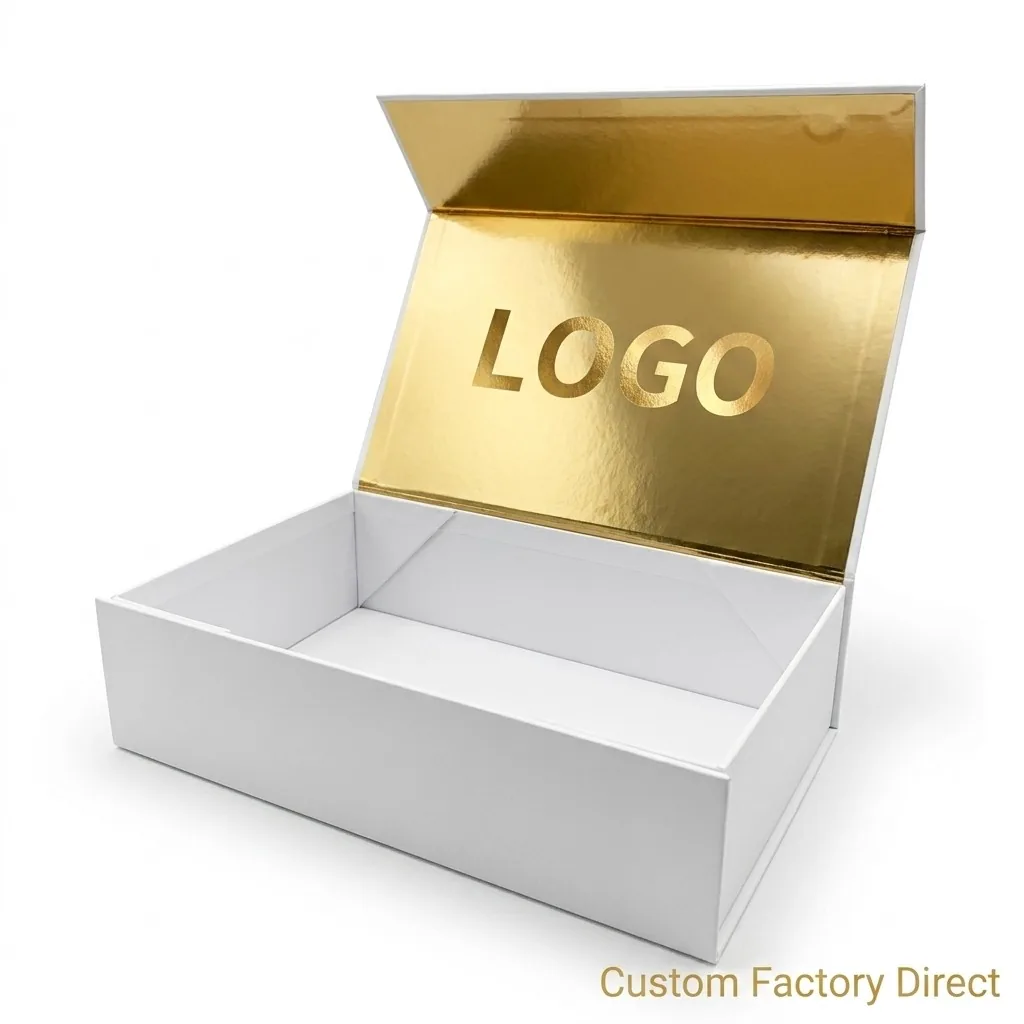
Rigid lid-and-base and magnetic book-style boxes are the premium formats — heavy board, wrap-around finishing, often an insert. They suit gifting, keepsakes and products where the box survives the purchase. Drawer and slide boxes add an opening motion that works well for gift sets and small electronics. Folding cartons — tuck-end, straight tuck, crash-lock — are the volume format: flat-shipped, cost-efficient, and the default for retail goods. Mailer boxes with self-locking bases are built for e-commerce: they assemble without tape and take printed branding on every panel, which matters because the parcel is often the first physical touchpoint with a customer. Window-patched cartons show the product itself where the product is the argument. Paper bags and handbags complete a retail set and carry the brand out of the store.
Match the structure to the job, then design the artwork around it. Doing it in the other order is the most common and most expensive sequencing error in packaging projects, because changing structure after artwork exists means rebuilding the artwork around a new dieline.
Stage three — match the print method to your quantity
5. Which print method, and at what quantity does it pay?
Printing economics split into two families. One carries meaningful setup cost and a low cost per unit once running — efficient at volume, wasteful at small quantities. The other carries little or no setup and a higher unit cost — sensible for short runs, samples and multiple design variants, and uneconomic at scale. Both are standard industry practice; what matters for your quote is which method the factory will actually run at your quantity, and where the price break between them sits. Ask that question directly, because a price that looks uncompetitive is often a price computed on the wrong method for your run size.
Two refinements follow. First, colour count and ink coverage change cost — a full-coverage dark panel consumes more ink than a mostly-white one, and each additional colour adds a pass. Second, every special finish is a separate operation with its own setup and minimum: hot foil stamping, embossing and debossing, spot UV, and matte or gloss lamination — the surface options are compared in our guide to 20 packaging lamination films. Where foil and emboss are combined on the same panel, the order they run in and the clearance cut into the dies decide the result — see process order, depth and the defects behind foil and emboss rework. A finish that is economical at 5,000 pieces can be uneconomic at 300, and the reverse is also true, since some finishes are applied per sheet rather than per unit.
Budget and quantity are therefore one decision, not two. If you want to see how the components add up, our guide to why packaging quotes differ breaks the price into its five variables.
Stage four — settle the details that cause reprints
6. Do you need a spot colour?
There is a clean rule of thumb. If a specific brand colour must reproduce exactly and consistently — a fixed corporate colour or a distinctive signature tone — that element should be printed as a spot colour, mixed to a defined reference rather than built from four process inks. If the panel carries photography, gradients or illustration with subtle tonal range, process (four-colour) printing reproduces it better. Many packs need both, with the logo in spot colour and the imagery in process.
One thing to settle regardless: the colour you see on screen is not the colour the press lays down. Screen colour is emitted light in RGB; press colour is reflected ink in CMYK. Converting between them shifts saturated tones, and no amount of care in the file removes the need to approve a physical proof. Approving colour on a screen is the single most common cause of "the boxes came back the wrong colour" — a complaint that is really a proofing decision made too late. For the file-side detail — bleed, dielines, editable type and separated finish layers — see why AI packaging artwork fails in print.
7. What does your target market require?
Requirements differ by market and by product category. Panels may be expected to carry ingredient or material statements, net contents, manufacturer or importer details, batch codes, best-before dates, warning text and recycling or disposal marks — and many markets set minimum type sizes and contrast rules for that information. Sourcing decisions carry documentation expectations too: buyers increasingly need to show where fibre came from and what the material contains.
This is much cheaper to settle before printing than after. Ask for the certificate set and the material documentation in the same message as the quote, and name the destination market explicitly, because the same box sold into two regions can need two different panels. We publish our certificate set — ISO 9001, ISO 14001, FSC, BSCI, SMETA and SGS — and offer FSC-certified board and recycled material options where the specification allows it. Ask what your market requires; do not assume the previous project's paperwork still applies.
8. When do you need it in hand? Work backwards, not forwards.
Purchasing teams usually work forwards from today and discover the problem late. The reliable method is to work backwards from the in-hand date and subtract each stage: transit, then production, then sampling, then artwork. Production does not begin at order confirmation — it begins after artwork approval, because the press needs an approved file. As a working reference, a printed physical sample on our core lines runs 1–3 days, and production runs 10–15 days from artwork approval, with freight time on top of that.
Seen that way, the binding deadline is not the order date, it is the artwork-freeze date. If a file needs rebuilding, the schedule absorbs it before production — which is why artwork problems surface as missed deliveries rather than as extra design time. For seasonal programmes, confirm the supplier's capacity window for your market early rather than assuming the standard timeline holds through a peak.
Stage five — choose the partner
9. How do you choose a manufacturer?
Price per unit is a weak signal on its own, because it says nothing about what happens when something goes wrong. A more useful screen is to ask about capability and then verify it. Which presses will run the job? What colour measurement equipment is used to check a run? What is produced in-house and what is subcontracted? Who owns the dieline, and will you receive it? What are the inspection stages, and what is the rework policy if a batch fails?
Two structural questions deserve their own weight. First, does the supplier handle structure, print, finishing and inserts as one scope, or will you be coordinating four vendors and absorbing the mismatch between them? Second, how can you verify a factory you have not visited? Remote verification is now routine: third-party audits, video walkthroughs and platform-verified supplier status. Our own profile is checkable that way — a 7,500 m² factory in Shenzhen, 200+ craftspeople, packaging for brands in more than 30 countries since 2015, and a verified supplier presence on Alibaba.com with Trade Assurance and an on-site check by Intertek. Ask for the same evidence from every quote you are comparing.
10. Will you sample before the run?
Always sample. A physical sample is the only way to check the things a file cannot show: how the board feels in the hand, whether the structure assembles cleanly, whether an insert actually holds the product without movement, whether fine detail in foil or embossing survives the process, and whether the colour matches the proof you approved. Screens and PDFs are not samples.
When you receive a sample, test it the way a customer will — open it, close it, load it, drop it. Sample lead time on our core lines is 1–3 days, which is short enough that skipping it buys almost nothing and risks a full run produced to an approved-but-wrong specification.
11. How is quality controlled batch to batch?
A good answer names stages and responsibilities, not adjectives. The standard structure runs in three parts: a first-article check before the run starts, confirming the sheet matches the approved sample; in-process inspection during the run, watching registration, colour drift, foil adhesion and gluing as the machine runs; and final inspection before packing, sampling finished pieces against the approved standard.
Ask two follow-up questions. What happens if a batch does not pass — is it reworked, reprinted, or shipped with a concession? And what is the reject rate on comparable jobs, because a supplier who tracks quality can answer that and one who does not will deflect. These are the questions that determine whether a cheap quote stays cheap.
The brief, on one page
1. What is going inside — weight, shape, count, fragility
2. Who it is for — value-driven or premium
3. What the pack must do — shelf appeal, transit protection, or both
4. Which structure — rigid, drawer, folding carton, mailer, window, bag
5. Which print method, and at what quantity it pays
6. Spot colour for fixed brand tones, process colour for imagery
7. Target-market labelling and material documentation
8. In-hand date, worked backwards to the artwork-freeze date
9. Manufacturer capability — presses, colour control, in-house scope, verification
10. Sampling before the run
11. Quality control across three inspection stages
Bring those eleven answers to a supplier and the quote you get back can actually be compared with the next one. If you would rather work through them with someone, send us the product, the market and the in-hand date — we will come back with structure options, material recommendations and a quote, along with a free 3D mockup of the direction we are proposing.