When sourcing custom packaging for your products, one of the most common decisions is whether to use folding cartons (collapsible rigid boxes) or traditional rigid boxes (non-collapsible). Both have their place in the market, but the right choice depends heavily on size, shipping volume, inner structure, and budget.
In this article, we'll break down the key factors that should guide your decision — transportation efficiency, product dimensions, insert design, and durability — so you can make an informed choice for your next custom packaging order.
1. Size & Shipping Volume: The Decisive Factor
The biggest advantage of folding cartons is their ability to be flattened before assembly. This drastically reduces the space they occupy during storage and transit.
Let's look at a real example — box size: 30 (L) × 20 (W) × 15 (H) cm, qty: 500 pcs.
When a magnetic folding box is pressed flat, the panels unfold and the footprint changes. The flat length equals 3H + 2W (three height panels and two width panels laid end to end), the flat width stays at L, and each flattened box is approximately 1 cm thick:
| Format | Per-box volume calculation | Total volume (500 pcs) |
|---|---|---|
| Non-collapsible (assembled) | 0.30 × 0.20 × 0.15 = 0.009 m³ | 4.5 m³ |
| Folding carton (flat) | (3×0.15 + 2×0.20) × 0.30 × 0.01 = 0.00255 m³ | 1.275 m³ |
That's a saving of 3.225 m³, reducing shipping volume by approximately 71.7%. The volume ratio between assembled and flat is about 3.5:1 — which is exactly why logistics providers quote 3–4× lower freight for flat-packed boxes. The math and the real-world freight data match.
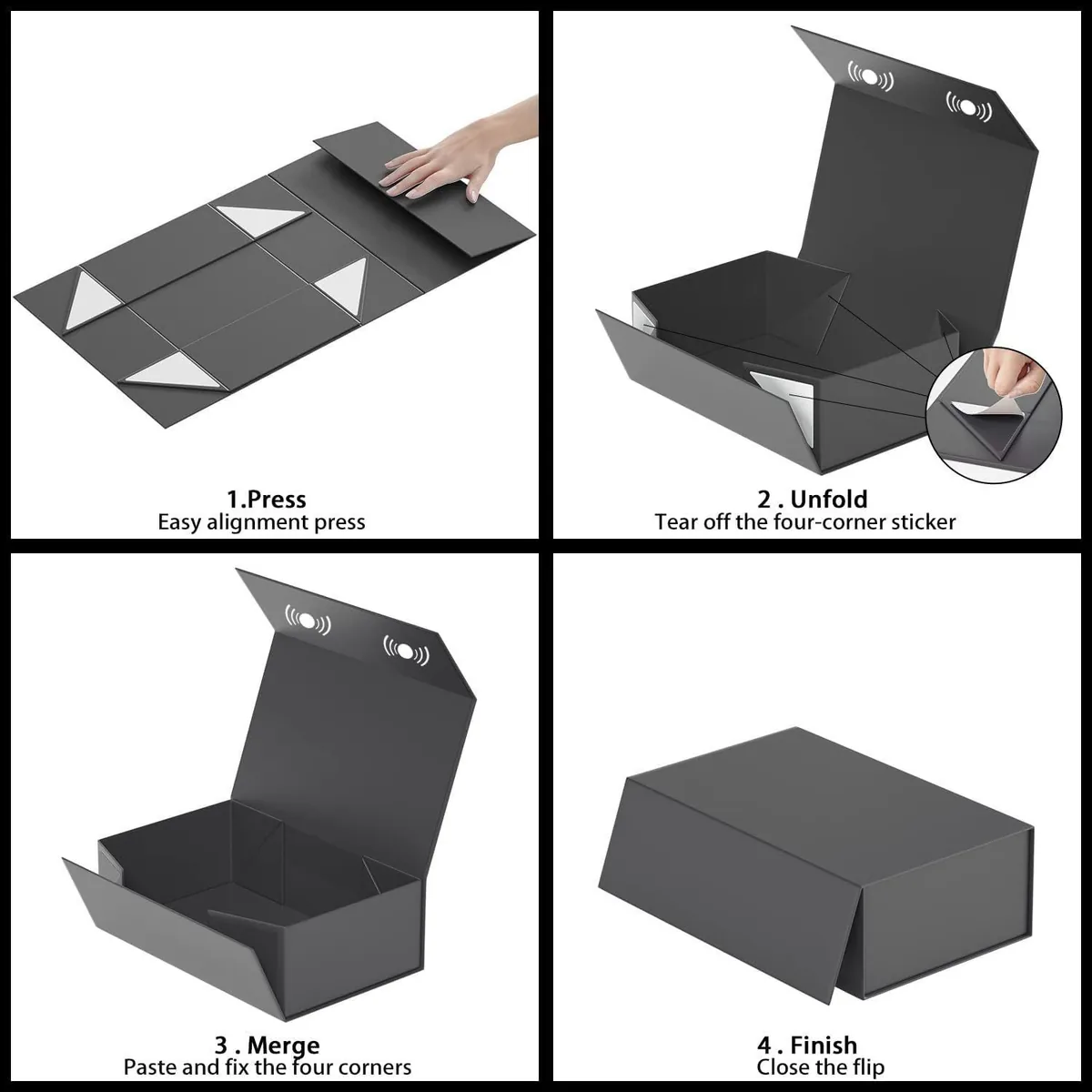
A collapsible magnetic gift box ships flat and assembles in four steps at your warehouse — press, unfold, merge corners, close.
Key takeaway: If your boxes are large (e.g., any dimension > 25 cm), folding cartons are almost always the smarter choice — even if the order quantity is small. The cubic volume adds up quickly.
2. When Small Sizes Make Folding Unnecessary
On the flip side, if your box dimensions are small — say under 15 cm in all directions — the savings from folding become marginal. A small rigid box already takes up very little space, and the extra cost of making it collapsible may not be justified.
Why? Because producing a folding carton involves additional die-cutting, scoring, and sometimes gluing steps that a standard rigid box does not require. This drives up manufacturing cost.
Based on industry experience, the production cost of a folding carton is roughly 10% higher than that of an equivalent non-collapsible rigid box. For small quantities or small sizes, that extra 10% often outweighs any shipping benefit.
Recommendation: For boxes smaller than ~15 cm in all dimensions, stick with standard rigid boxes. They are simpler to produce, cheaper per unit, and shipping volume is negligible anyway.
3. Inner Inserts: A Critical Design Challenge
Many products require foam inserts (EVA, polyethylene foam, etc.) to hold items securely inside the box. However, traditional foam inserts cannot be folded. Once glued into a rigid box, the entire assembly becomes permanently bulky and non-collapsible.
To achieve full collapsibility — where both the box and its insert flatten — you need paper-based inserts instead of foam. These are typically made from die-cut cardboard, corrugated board, or molded pulp, designed with score lines and locking tabs so they fold flat alongside the outer box.
This is not a simple swap. Designing a paper insert that provides the same level of protection as foam, while remaining foldable, requires significant engineering expertise. A reliable packaging factory will analyze your product's shape, weight, fragility, and orientation to create a custom paper-based insert that works perfectly within a folding carton system.
Key point: If you want folding boxes, ask your supplier about paper-based insert solutions. Not every factory has this capability — it truly tests their design and tooling skills.
4. Durability During Transit & Storage Space
Another often-overlooked advantage of folding cartons is their superior resistance to compression and impact during shipping.
Non-collapsible rigid boxes are fully assembled and empty inside. When stacked or packed tightly, they can easily deform, dent, or crush under pressure. Their thin walls and hollow structure offer limited structural support, leading to higher damage rates — especially in long-distance sea freight. We currently have a live order of 30 × 20 × 10 cm collapsible magnetic gift boxes where the logistics provider quoted 3–4× higher freight for the assembled version, and the assembled boxes showed meaningfully higher damage rates in transit testing.
Folding cartons, on the other hand, are shipped flat in sturdy bundles. The bundled sheets act as a dense block that resists crushing far better than individual assembled boxes. Once erected at the destination, the box's reinforced fold structure also tends to be more robust than a standard rigid box.
Additionally, because folding cartons arrive flat, they take up far less warehouse space before use — a major advantage for importers who store inventory for months before final assembly and distribution.
Summary: Folding cartons offer better protection in transit and significantly reduce your warehousing footprint — two benefits that directly improve your bottom line.
5. Aesthetics: A Compromise You Can't Ignore
Folding cartons are inherently a compromise. Because they must be scored and folded, visible creases, seams, and potential gaps are unavoidable — especially on corners and edges. Even with high-quality finishing, a folding carton rarely looks as seamless as a rigid box.
Standard rigid boxes, on the other hand, are formed around a mold and wrapped with paper or fabric. They offer sharp, clean edges, a solid feel, and a premium unboxing experience. For luxury goods, electronics, cosmetics, or gift packaging, the visual difference matters a lot. See our guide on how to choose the right rigid gift box for a full breakdown of materials and finishes.
Bottom line: If your brand relies on a "wow" factor and you want the highest perceived quality, choose rigid boxes whenever possible. Only switch to folding when the shipping cost penalty or damage risk becomes too heavy to absorb.
Summary Decision Guide
| Scenario | Recommended Option |
|---|---|
| Large boxes (> 25 cm in any dimension) | Folding cartons — save 80–90% shipping volume |
| Small boxes (< 15 cm in all dimensions) | Standard rigid boxes — lower cost, better aesthetics |
| Medium boxes (15–25 cm) | Evaluate both: compare shipping cost vs. 10% production premium |
| Products needing foam inserts | Standard rigid boxes (unless paper inserts are feasible) |
| Products needing inserts + foldability | Folding cartons with custom paper inserts — requires an experienced factory |
| High-volume / low-margin | Folding cartons — reduce logistics expenses |
| Premium / luxury presentation | Standard rigid boxes — unmatched appearance |
Final Thoughts
Choosing between folding cartons and rigid boxes isn't about one being "better" — it's about matching the solution to your specific product size, order volume, insert requirements, and brand positioning. Use the volume calculation above to estimate your shipping savings, then weigh them against the 10% production premium, insert feasibility, and aesthetic trade-offs.
If you need help calculating shipping volumes, designing paper-based inserts for folding cartons, or requesting a quote for either option, our team specialises in both formats for B2B clients worldwide.